Sunday, July 27, 2008

27 JULY 08


THE TENTH SUNDAY AFTER TRINITY

27 JULY 08

LECTIONARY READINGS

Morning Prayer: Psalm 145; Ecclesiasticus 1:1-10; John 8:25-36

Mass: 1 Corinthians 12:1-11; Luke 19:41-47a

Evening Prayer: Psalm 15, 46; Isaiah 44:1-8, 21-23; Romans 12:1-9

REFLECTION

Take a moment to look at the image at the top of this post. Imagine you are actually standing nearby, watching Jesus as he weeps over Jerusalem. What is it you feel? Do you sense and share His sadness, His anguish for the hopes he has for His people.

Consider for a moment that your heart represents Jerusalem and the holy Temple. Does your heart resemble that so-called city of peace, that place wherein God's presence was profoundly to be experienced, that place where sacrifice took place? Or, rather, is your heart more like what Jesus found in Jerusalem and the Temple...full of doubt, fear, cynicism, lust for power and prestige, full of oppression and depression, full of cheating, abounding with the shell of true religion...but empty and dead on the inside? Do we find Jesus weeping over the Jerusalem and Temple of our hearts?

Our hearts do not have to experience the same end that Jerusalem experienced in A.D. 70. We have the opportunity to change, to be transformed by repentance. We have the chance to clean our the cobwebs of our minds and hearts so that they may be renewed with the cleansing of the presence of the Holy Spirit, so that we may truly seek out Christ in true religion, in true sacrifice of ourselves for the will of Christ in our lives. Take time today to find a good place, alongside Jesus, to view the Jerusalem and Temple of your heart. What do you see, and what do you need to transform? Take time to truly listen to the Lord as He tell you His desires...His will...His dreams for your life.

Fr. Greg

THE COLLECT FOR THE TENTH SUNDAY AFTER TRINITY

Let thy merciful ears, O Lord, be open to the prayers of thy humble servants; and, that they may obtain their petitions, make them to ask such things as shall please thee; through Jesus Christ our Lord. Amen.

THE SAINT OF THE DAY

None for today

Wednesday, July 23, 2008

25 JULY 08


FRIDAY AFTER TRINITY IX

25 JULY 08

LECTIONARY READING

Morning Prayer: Psalm 22; 1 Samuel 17:28-40; Luke 19:1-10

Evening Prayer: Psalm 25; Micah 2; Roman 3:21-end

REFLECTION
The last couple of days I have spent time visiting with family in Tulsa, OK. My Aunt Betty had an operation to amputate the lower part of her left leg due to a severe case of the MRSA virus she acquired about a year ago. The doctor did everything he could to save the foot and leg, but the time arrived where we had to be realistic about the fact that the healing process had reached a plateau. All of the various antibiotics were not working satisfactorily.
Thoughout this past year there have been definite frustrations that my Aunt Betty has experienced. She has undergone a great deal of medication, several hospitalisations, has nearly been restricted to her house because of the IV medications and deteriorization of her ankle which caused her great difficulty in mobility. Even with the rough days, she has been a real trouper and has kept great hope in the midst of it all.
Even though the amputation is now complete, my Aunt still has great hope for the upcoming weeks and months. As my Niece, Miranda, has been saying, "Each hurdle that is crossed is a little victory." Well, there will continue to be a few more hurdles and victories to look forward to.
On my way back to our farm in the Ozarks this afternoon, I thought about how my Aunt's journey this past year is like our journey of discipleship with the Lord. There are very good patches of the journey where it seems progress is easily made, and then there are stretches of the journey that seem so very rocky and progress seems slow at best. Yet, like my Aunt, we can see these difficult parts of the journey with hope.
I also want to state emphatically how important family is. When a member of our family is going through difficult times, we should surround them with our love and support in whatever way we can. It is the same with the family of faith. When a member of our family of faith experiences difficulty, we should surround them with support, love, and mercy so that they might find healing even sooner. May we always strive to love with great mercy and healing compassion.
Fr. Greg

THE COLLECT FOR THE NINTH SUNDAY AFTER TRINITY
Grant to us, Lord, we beseech thee, the spirit to think and do always such things as are right; that we, who cannot do any thing that is good without thee, may by thee be enabled to live according to thy will; through Jesus Christ our Lord. Amen.

THE SAINT OF THE DAY

St. James, Apostle (1st century)


James the son of Zebedee and his brother John were among the twelve disciples of Our Lord. They, together with Peter, were privileged to behold the Transfiguration (M 17:1 = P 9:2 = L 9:28), to witness the healing of Peter's mother-in-law (P 1:29) and the raising of the daughter of Jairus (P 5:37 = L 8:51), and to be called aside to watch and pray with Jesus in the garden of Gethsemane on the night before His death (M 26:37 = P 14:33).
James and John were apparently from a higher social level than the average fisherman. Their father could afford hired servants (P 1:20), and John (assuming him to be identical with the "beloved disciple") had connections with the high priest (J 18:15). Jesus nicknamed the two brothers "sons of thunder" (P 3:17), perhaps meaning that they were headstrong, hot-tempered, and impulsive; and so they seem to be in two incidents reported in the Gospels. On one occasion (L 9:54ff), Jesus and the disciples were refused the hospitality of a Samaritan village, and James and John proposed to call down fire from heaven on the offenders. On another occasion (M 20:20-23 = P 10:35-41), they asked Jesus for a special place of honor in the Kingdom, and were told that the place of honor is the place of suffering.
Finally, about AD 42, shortly before Passover (Acts 12), James was beheaded by order of King Herod Agrippa I, grandson of Herod the Great (who tried to kill the infant Jesus--Matthew 2), nephew of Herod Antipas (who killed John the Baptist--Mark 6--and examined Jesus on Good Friday--Luke 23), and father of Herod Agrippa II (who heard the defence of Paul before Festus--Acts 25). James was the first of the Twelve to suffer martyrdom, and the only one of the Twelve whose death is recorded in the New Testament.

James is often called James Major (= greater or elder) to distinguish him from other New Testament persons called James. Tradition has it that he made a missionary journey to Spain, and that after his death his body was taken to Spain and buried there. at Compostela (a town the name of which is commonly thought to be derived from the word "apostle", although a Spanish-speaking listmember reports having heard it derived from "field of stars", which in Latin would be campus stellarum). His supposed burial place there was a major site of pilgrimage in the Middle Ages, and the Spaniards fighting to drive their Moorish conquerors out of Spain took "Santiago de Compostela!" as one of their chief war-cries. (The Spanish form of "James" is "Diego" or "Iago". In most languages, "James" and "Jacob" are identical. Where an English Bible has "James," a Greek Bible has IAKWBOS.)

***by James Kiefer at www. satucket.com***

THE COLLECT FOR ST. JAMES THE APOSTLE

O gracious God, we remember before thee this day thy servant and apostle James, first among the Twelve to suffer martyrdom for the Name of Jesus Christ; and we pray that thou wilt pour out upon the leaders of thy Church that spirit of self-denying service by which alone they may have true authority among thy people; through the same Jesus Christ our Lord, who liveth and reigneth with thee and the Holy Spirit, one God, now and for ever. Amen.

24 JULY 08


THURSDAY AFTER TRINITY IX

24 JULY 08

LECTIONARY READINGS

Morning Prayer: Psalm 10; 1 Samuel 17:17-27; Luke 18:31-end

Evening Prayer: Psalm 21:1-6 & 24; Micah 1:1-7a; Romans 3:1-20

REFLECTION

Today's Gospel reading, found in Morning Prayer, tells about Jesus walking toward Jerusalem. Along the way a blind man cries out, "Jesus, thou Son of David, have mercy on me." Jesus has compassion on him and heals him.

With the many things in life that plague us with physical, emotional, spiritual, and moral illness, do we cry out to the Lord for His mercy? What are those things in your life that worry you, that you carry around as a weight on your back, that stresses you out, that depresses you? Write them down and decide what you want to do about them. You can either continue to try to carry the load by yourself, or you can invite the Lord's mercy into your life and thereby cooperate with His grace to find healing.

What about the people in your life that cry out in various to you for mercy? In what way are you Jesus to them? Do you provide mercy, and if not, why not? How might you change that?

Have a blessed day in Christ!

Fr. Greg

THE COLLECT FOR THE NINTH SUNDAY AFTER TRINITY

Grant to us, Lord, we beseech thee, the spirit to think and do always such things as are right; that we, who cannot do any thing that is good without thee, may by thee be enabled to live according to thy will; through Jesus Christ our Lord. Amen.

THE SAINT OF THE DAY

None for today

Monday, July 21, 2008

22 JULY 08


TUESDAY AFTER TRINITY IX
22 JULY 08

LECTIONARY READINGS

Morning Prayer: Psalm 5; 1 Samuel 16:14-end; Luke 18:1-14

Evening Prayer: Psalm 16, 20; Esther 6; Romans 2:1-16

REFLECTION

Gospel: Luke 7:36-50

"Amazing Grace, how sweet the sound, that saved a wretch like me. I once was lost, but now am found. Twas blind, but now I see."

I don't know about you, but the first stanza of the hymn Amazing Grace is so powerful in its truth. In much the same way, I find the Feast of St. Mary Magdalene full of hope. It is a feast that shines brightly to the world around us, as well as to those of us in the Church. It is a true story of a person, as woman, whose sins were very great. Not only was she caught up, for whatever reasons, in the web of the sins of the flesh, scripture says that our Lord also cast out seven demons from her.

In today's Gospel lesson we find Jesus sharing a meal with a Pharisee. Suddenly Mary Magdalene arrives with a box of ointment, weeping, and she washes Jesus' feet, dries them with her hair, and applies ointment. The Pharisee is shocked that Jesus would let this unclean woman touch him, or even be in his presence. Jesus tells a parable of a creditor who had two debtors. One owed much, the other not as much. The creditor forgives the debts of both debtors. The bottom line of the parable is that the debtor who owed much loved Jesus most because of the great debt he had that was forgiven. Jesus likens Mary Magdalene to the debtor who owed much.

Mary desires to be clean, to be forgiven, to be renewed and refreshed in our mind, heart and soul. The redirects her passions from those sins of the flesh to seeking out Jesus so that she might passionately find forgiveness and solace for our soul. She passionately shows her gratitude to Jesus by her actions.

What about you and me? Have we sought out Jesus with the same passion and desire to be cleansed of our sins, to be transformed into the likeness of Christ? Do our lives reflect Christ in such a way to the world we come into contact with that Jesus is The Way, The Truth, and The Life? Do our lives reflect the grace, mercy, compassion, and love that can only transform our hearts and minds from that which we have allowed it to become, to that which God would have us to be? Are we ready to clean out all the cobwebs and skeletons we harbour in the dark closets of our lives by shining the light of God's grace and mercy? Are our lives a reflection of Jesus in such a way that those around us passionately desire to seek out Jesus as St. Mary Magdalene did?

St. Mary Magdalene went on to become an Apostle to the Apostle on that first Easter morning. After Jesus ascended into heaven, she continued to be a vibrant and powerful witness to the people who knew her of the life transforming power of our Lord, God, and Saviour Jesus Christ. The Eastern Orthodox Church considers who "Equal to the Apostles" because of her bright witness of Jesus to the world. May we passionately follow after her example and seek to be witnesses to God's amazing grace!

Fr. Greg

THE COLLECT FOR THE NINTH SUNDAY AFTER TRINITY

Grant to us, Lord, we beseech thee, the spirit to think and do always such things as are right; that we, who cannot do any thing that is good without thee, may by thee be enabled to live according to thy will; through Jesus Christ our Lord. Amen.

THE SAINT OF THE DAY

St. Mary Magdalene, Penitent (1st century)

Mary Magdalene is mentioned in the Gospels as being among the women of Galilee who followed Jesus and His disciples, and who was present at His Crucifixion and Burial, and who went to the tomb on Easter Sunday to annoint His body. She was the first to see the Risen Lord, and to announce His Resurrection to the apostles. Accordingly, she is referred to in early Christian writings as "the apostle to the apostles."
Mary Magdalene, Mary of Bethany (sister of Martha and Lazarus), and the unnamed penitent woman who annointed Jesus's feet (Luke 7:36-48) are sometimes supposed to be the same woman. From this, plus the statement that Jesus had cast seven demons out of her (Luke 8:2), has risen the tradition that she had been a prostitute before she met Jesus.
Because of the assumption that Mary Magdalene had been a spectacular sinner, and also perhaps because she is described as weeping at the tomb of Jesus on the Resurrection morning, she is often portrayed in art as weeping, or with eyes red from having wept. From this appearance we derive the English word "maudlin", meaning "effusively or tearfully sentimental." There is a Magdalen College at Oxford, and a Magdalene College at Cambridge (different spelling), both pronounced "Maudlin."

THE COLLECT FOR ST. MARY MAGDALENE
Merciful Father, give us grace that we never presume to sin through the example of any creature : but if it shall chance us at any time to offend thy divine majesty, that then we may truly repent, and lament the same after the example of Mary Magdalene ; and by lively faith obtain remission of all our sins. through the only merits of thy Son our Lord and Saviour Jesus Christ. Who liveth and reigneth with thee. One God, world without end. Amen.

Friday, July 18, 2008

19 JULY 08


SATURDAY AFTER TRINITY VIII

19 JULY 08


LECTIONARY READINGS


Morning Prayers: Psalm 145: 1 Samuel 15:24-34; Luke 17:11-19


Evening Prayers: Psalm 147; Esther 4:1, 5-17; Acts 28:16-end


REFLECTIONS

In the Gospel lesson today from Morning Prayer we find Jesus meeting a group of ten lepers along the way. Lepers were complete outcasts from their society, seen as unclean, sinful, and to be avoided at all costs. Yet, Jesus has compassion on them and enters into their world. Going against the grain of Jewish culture and religious law, Jesus comes close to these lepers by listening to their story...and by healing them.

So that these men might enjoy the benefits of being reintegrated into mainstream society, Jesus sends them to the priests of the Temple so the priests might see them and declare them clean...healed. After they are declared clean, only one of them returns to Jesus out of deep gratitude. Jesus sends him on his way declaring, "...your faith has made you whole."

Why are we so afraid to enter into the lives of those our society, even some religious authorities, declare unclean, especially when we have these kinds of examples that our Lord has lived before us? Are there people who are so unclean, so unworthy, as not to merit the compassion of our Lord? What about our compassion?

Are there people in your life that live on the fringe, the margin, the edge of accepted society who need healing? Are you willing to simply follow the example of Jesus and enter into relationship with such persons and begin that process of healing the Lord so desire to work through you?

Be blessed in Christ!

Fr. Greg


QUOTES TO CONSIDER


"We want to lower the bar of how church is done and raise the bar of what it means to be a disciple."

"We have come to understand the Church as this: the presence of Jesus among His people called out as a spiritual family to pursue His mission on this planet."

"Unfortunately, in most churches in the Western world the presence of the pastor is more noticeable than the presence of Jesus."

***From Organic Church: Growing Faith Where Life Happens, Neil Cole, Jossey-Bass, 2005***

THE COLLECT FOR THE EIGHTH SUNDAY AFTER TRINITY


O God, whose never-failing providence ordereth all things both in heaven and earth; We humbly beseech thee to put away from us all hurtful things, and to give us those things which are profitable for us; through Jesus Christ our Lord. Amen.


THE SAINT OF THE DAY


St. Vincent De Paul (1581-1660)


After graduating with a degree in theology, St. Vincent De Paul was troubled with the plight of the many poor people he came into contact with. The situation was so distressing for many families that they were leaving their young infants at churches. St. Vincent spent a lifetime establishing homes for orphans and organisations that assisted the poor, of which several remain to this day. His body remain incorrupt.

THE COLLECT FOR ST. VINCENT DE PAUL

O God, who didst endue thy blessed Saint Vincent with apostolic virtue, to the intent that he should preach thy Gospel to the poor, and stablish the honour of the priesthood of thy Church : grant, we beseech thee ; that we may so hold in reverence his works of righteousness, that we may learn to follow the patern of his godly conversation. Through Jesus Christ our Lord. Amen.

Wednesday, July 16, 2008

17 JULY 08


THURSDAY AFTER TRINITY VIII

17 JULY 08

LECTIONARY READINGS

Morning Prayer: Psalm 128, 129; 1 Samuel 15:1-9; Luke 16:19-end

Evening Prayer: Psalm 132, 134; Esther 2:5-8, 17-23; Acts 27:27-end

REFLECTION

Today, read the Gospel reading found in Morning Prayer. Read it through several times, slowly. Take time out today to take a very close look at the image at the top of this post as it relates to the Gospel reading today. What do you see? Are you more like the Rich Man, or are you more like Lazarus? Who are the Lazarus' in your daily life?

Fr. Greg

QUOTES TO CONSIDER


"It is not the local church that will change the world; it is Jesus. Attendance on Sundays does not transform lives; Jesus within their hearts is what changes people."
"Instead of bringing people to church so that we can bring them to Christ, let's bring Christ to people where they live. we may find that new church will grow out of such an enterprise, a church that is more centered in life and the workplace, where the Gospel is supposed to make a difference. What will happen if we plant the seed of the Kingdom of God in the places where life happens and where society is formed."
"If you want to win this world for Christ, you are going to have to sit in the smoking section. That is where lost people are found and if you make them put their cigarette out to hear the message they will be thinking about only one thing: 'When can I get another cigarette.'"
"The heart of our message is that God didn't expect us to come to Him in heaven. He came to us. He lived life on our terms and on our turf."
***From Organic Church: Growing Faith Where Life Happens, Neil Cole, Jossey-Bass, 2005***
THE COLLECT FOR THE EIGHTH SUNDAY AFTER TRINITY

O God, whose never-failing providence ordereth all things both in heaven and earth; We humbly beseech thee to put away from us all hurtful things, and to give us those things which are profitable for us; through Jesus Christ our Lord. Amen.

THE SAINT OF THE DAY

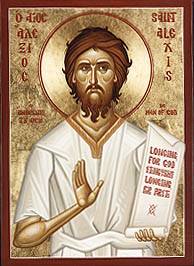
St. Alexius, Confessor (5th century)

St Alexis was born at Rome into the family of the pious and poverty-loving Euphemianus and Aglais. The couple was childless for a long time and constantly prayed the Lord to grant them a child. And the Lord consoled the couple with the birth of their son Alexis. At six years of age the child began to read and successfully studied the mundane sciences, but it was with particular diligence that he read Holy Scripture. When he was a young man, he began to imitate his parents: he fasted strictly, distributed alms and beneath his fine clothing he secretly wore a hair shirt. Early on there burned within him the desire to leave the world and serve God. His parents, however, had arranged for Alexis to marry a beautiful and virtuous bride. On his wedding night, Alexis gave her his ring and his belt (which were very valuable) and said, "Keep these things, Beloved, and may the Lord be with us until His grace provides us with something better." Secretly leaving his home, he boarded a ship sailing for Mesopotamia. Arriving in the city of Edessa, where the Icon of the Lord "Not-made-by-Hands" (August 16) was preserved, Alexis sold everything that he had, distributed the money to the poor and began to live near the church of the Most Holy Theotokos under a portico. The saint used a portion of the alms he received to buy bread and water, and he distributed the rest to the aged and infirm. Each Sunday he received the Holy Mysteries. The parents sought the missing Alexis everywhere, but without success. The servants sent by Euphemianus also arrived in Edessa, but they did not recognize the beggar sitting at the portico as their master. His body was withered by fasting, his comeliness vanished, his stature diminished. The saint recognized them and gave thanks to the Lord that he received alms from his own servants. The inconsolable mother of St Alexis confined herself in her room, incessantly praying for her son. His wife also grieved with her in-laws. St Alexis dwelt in Edessa for seventeen years. Once, the Mother of God spoke to the sacristan of the church where the saint lived: "Lead into My church that Man of God, worthy of the Kingdom of Heaven. His prayer rises up to God like fragrant incense, and the Holy Spirit rests upon him." The sacristan began to search for such a man, but was not able to find him for a long time. Then he prayed to the Most Holy Theotokos, beseeching Her to clear up his confusion. Again a voice from the icon proclaimed that the Man of God was the beggar who sat in the church portico. The sacristan found St Alexis and brought him into the church. Many recognized him and began to praise him. The saint secretly boarded a ship bound for Cilicia, intending to visit the church of St Paul in Tarsus. But God ordained otherwise. A storm took the ship far to the West and it reached the coast of Italy. The saint journeyed to Rome and decided to live in his own house. Unrecognized, he humbly asked his father's permission to settle in some corner of his courtyard. Euphemianus settled Alexis in a specially constructed cell and gave orders to feed him from his table. Living at his parental home, the saint continued to fast and he spent day and night at prayer. He humbly endured insults and jeering from the servants of his father. The cell of Alexis was opposite his wife's windows, and the ascetic suffered grievously when he heard her weeping. Only his immeasurable love for God helped the saint endure this torment. St Alexis dwelt at the house of his parents for seventeen years and the Lord revealed to him the day of his death. Then the saint, taking paper and ink, wrote certain things that only his wife and parents would know. He also asked them to forgive him for the pain he had caused them. On the day of St Alexis' death in 411, Archbishop Innocent (402-417) was serving Liturgy in the presence of the emperor Honorius (395-423). During the services a Voice was heard from the altar: "Come unto Me, all ye who labor and are heavy laden, and I will give you rest" (Mt.11:28). All those present fell to the ground in terror. The Voice continued: "On Friday morning the Man of God comes forth from the body; have him pray for the city, that you may remain untroubled." They began to search throughout Rome, but they did not find the saint. Thursday evening the Pope was serving Vigil in the Church of St Peter. He asked the Lord to show them where to find the Man of God. After Liturgy the Voice was heard again in the temple: "Seek the Man of God in the house of Euphemianus." All hastened there, but the saint was already dead. His face shone like the face of an angel, and his hand clasped the paper, and they were unable to take it. They placed the saint's body on a cot, covered with costly coverings. The Pope and the Emperor bent their knees and turned to the saint, as to one yet alive, asking him to open his hand. And the saint heard their prayer. When the letter was read, the righteous one's wife and parents tearfully venerated his holy relics. The body of the saint was placed in the center of the city. The emperor and the Pope carried the body of the saint into the church, where it remained for a whole week, and then was placed in a marble crypt. A fragrant myrrh began to flow from the holy relics, bestowing healing upon the sick. The venerable relics of St Alexis, the Man of God, were buried in the church of St Boniface. The relics were uncovered in the year 1216.

THE COLLECT FOR ST. ALEXIUS

O God, who makest us glad with the yearly feast of blessed Alexius, thy Confessor : mercifully grant, that, as we now observe his heavenly birthday, so we may follow him in all virtuous and godly living. Through Jesus Christ our Lord. Amen.

Monday, July 14, 2008

15 JULY 08


TUESDAY AFTER TRINITY VIII

15 JULY 08

LECTIONARY READINGS

Morning Prayer: Psalm 111, 114; 1 Samuel 11:14-12:5; Luke 15:11-end

Evening Prayer: Psalm 118; Daniel 6:9-15; Acts 26:24-27:8

REFLECTION

Today I would like to consider some thoughts on Psalm 118, found in Evening Prayer. The constant refrain we hear in this Psalm is "for His mercy endureth forever." Have you consider the characteristics of the Lord's mercy? Have you experienced His mercy? Have you seen the imprint of His mercy in the lives of other people?

The Psalmist today calls on various aspects of Israel's society, the house of Aaron, those the fear the Lord, those who are in trouble, etc., to give thanks to the Lord because they know that His mercy endures forever. The Psalmist tells us that he has been under great stress because many people have been after him, have desired to do him harm. Yet, the Lord has protected him. The Psalmist has sought the Lord's strength. In the end, the Psalmist proclaims "this is the day the Lord has made, let us rejoice and be glad in it." We are shown that even though we may be experiencing all kinds of stress and difficulties in life, we can know the Lord is with us and gives us His mercy.

How might you and I share the reality of the Lord's mercy with those around us who may not know the Lord? Are there ways the Lord might use you to be His mouth piece, hands, feet, etc., of mercy to those in your life who need mercy? Truly, may our lives declare boldly that we give to the Lord for His great mercy.

Have a blessed day in Christ!

Fr. Greg


THE COLLECT FOR THE EIGHTH SUNDAY AFTER TRINITY

O God, whose never-failing providence ordereth all things both in heaven and earth; We humbly beseech thee to put away from us all hurtful things, and to give us those things which are profitable for us; through Jesus Christ our Lord. Amen.
THE SAINT OF THE DAY

The translation of St. Swithun, bishop, confessor (800-862)

Swithun entered the monastery of Winchester, and became a priest therein. King Egbert of the West Saxons heard of his fame and gave his son Ethelwulf into his care; and when this prince years afterwards succeeded to the kingdom, he nominated Swithun Bishop of Winchester, with the consent of the Archbishop of Canterbury and his clergy. thereafter, in his dudty towards his See, Swithun left nothing undone which is the part of a faithful shepherd. He shrank from all display and gaining of glory in the sight of men, and desired nothing more than that all the good which he did should be unknown save to God and to his own conscience. When he was dying, (to wit, on July 2nd 862), he expressed the wish that his body should be laid in the earth outside the church, under the open sky, that the feet of them that came thither might pass ofver him, and that the rain and the dew might fall upon him; and his lowly wish was carried out. Wherefrom hath sprung the belief that because of his love of both sunshine and rain, God doth ever grant his reuest for either, whichever he preferreth for his feast day, and for forty days continuously thereafter. But when the new Cathedral Church of Winchester was built, theh relicks of blessed Swithun were translated thereto, to wit, in 1093.

THE COLLECT FOR THE TRANSLATION OF ST. SWITHUN

Almighty and everlasting God, who hast made this day honourable unto us by reason of the festival of blessed Swithun thy Confessor and Bishop ; grant, we beseech thee ; that thy Church may so rejoice in this solemnity, that we which on this day do honour him on earth may by his intercession obtain thy succour in heaven. Through Jesus Christ our Lord. Amen.